


From Digital Adoption to Digital Transformation:
What the 2026 Caribbean Port Digitalisation Report Tells Us
By Tsahai Morgan | PMAC Digitalisation Working Group
 When the Port Management Association of the Caribbean (PMAC) Digitalisation Working Group launched the Caribbean Port Digitalisation Survey in 2024, the objective was straightforward: establish a regional benchmark that would allow Caribbean ports to measure progress, identify common challenges, and learn from one another. Three years later, the survey has evolved into one of the region’s most comprehensive assessments of digital maturity, capturing responses from 18 Caribbean territories and providing valuable insight into how digital transformation is reshaping maritime operations. This year’s findings reveal something significant. Caribbean ports are no longer asking whether digital transformation is necessary. The conversation has shifted to how ports can accelerate implementation, connect systems, strengthen resilience, and prepare for a future increasingly shaped by artificial intelligence and data-driven decision-making.
Digital maturity continues to advance
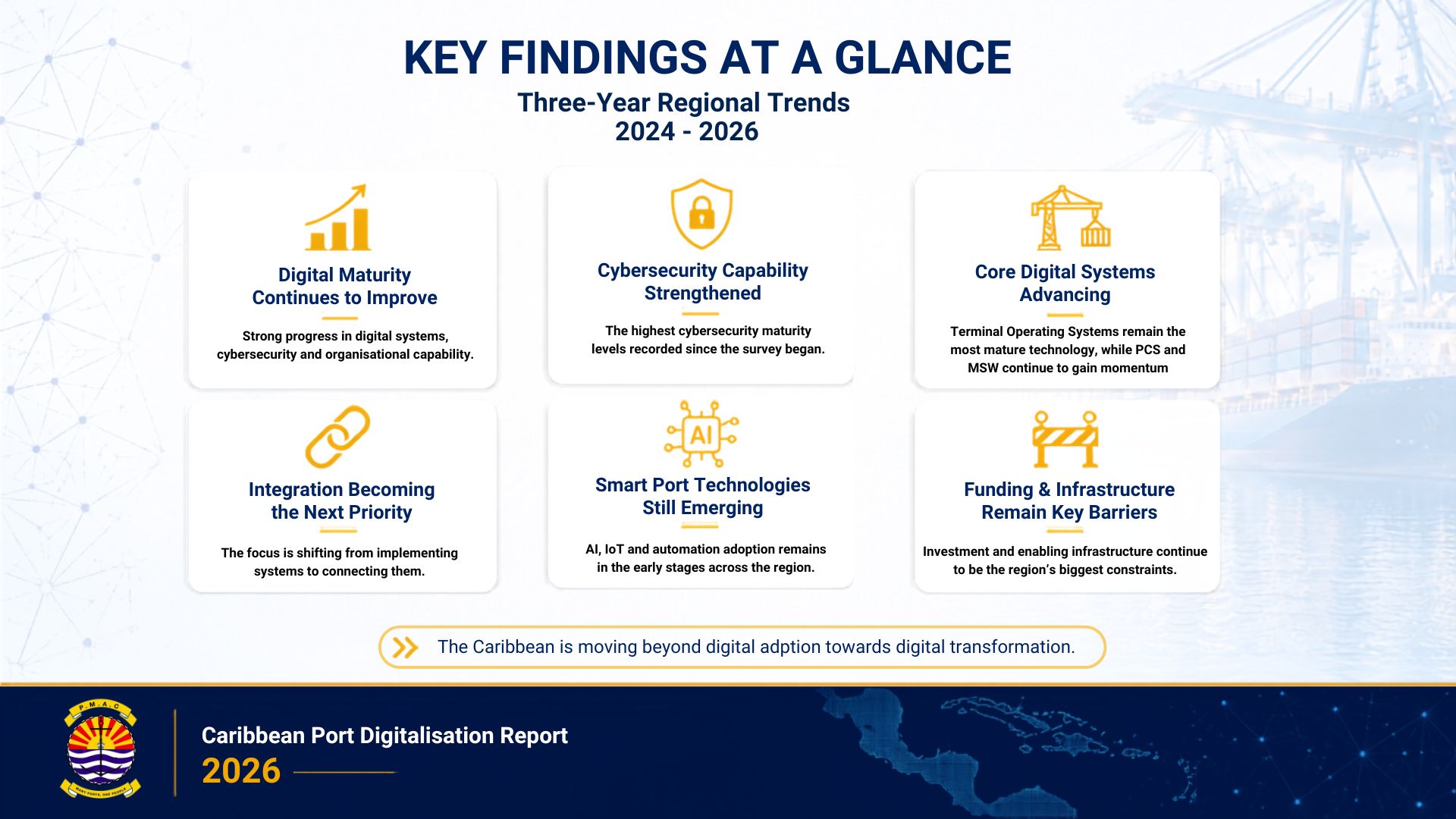
Perhaps the most encouraging finding from the 2026 Caribbean Port Digitalisation Report is that digital maturity continues to improve across virtually every area measured. The region has made measurable gains in operational systems, organisational capabilities and cybersecurity readiness, demonstrating that many investments initiated over recent years are beginning to produce tangible results.
Terminal Operating Systems (TOS) remain the cornerstone of digital operations, with 84% of responding organisations reporting that they have either implemented a TOS or are actively implementing one. Even more encouraging is the shift from planning to execution. Projects that sat on roadmaps in previous years are now entering active implementation, suggesting growing confidence in digital investment across the region.
The survey also highlights continued progress in Port Community Systems (PCS) and Maritime Single Windows (MSW). While implementation levels have remained relatively stable compared with 2025, these initiatives have emerged as the region’s highest digital priorities because they represent the next stage of transformation: connecting organisations rather than simply digitising them individually.
Integration is becoming the next frontier
If the first phase of digital transformation focused on implementing core systems, the next phase is clearly about integration.
The survey shows that Caribbean ports increasingly recognise the importance of connecting terminal systems with customs, shipping lines, government agencies and logistics stakeholders. This evolution reflects a broader understanding that digital transformation delivers its greatest value when information flows seamlessly across the entire maritime supply chain.
Regional priorities have therefore shifted toward expanding Port Community Systems and Maritime Single Windows while maintaining investment in Terminal Operating Systems as the operational backbone of modern ports. Together, these technologies form the foundation for more transparent, efficient and collaborative trade ecosystems.
Better decisions remain the biggest driver
One of the survey’s most consistent findings over the past three years is that digital transformation is fundamentally about improving decision-making.
Respondents rated improved access to data for decision-making as the greatest expected benefit of digitalisation, followed by operational efficiency and enhanced productivity. Better visibility into operations enables port managers to optimise resources, reduce bottlenecks, improve customer service and make faster, more informed operational decisions.
Cybersecurity shows encouraging progress
The 2026 survey recorded the highest cybersecurity maturity levels since the benchmarking exercise began.
Skills development has also improved considerably, particularly in cybersecurity competencies. While these improvements are encouraging, cybersecurity remains an ongoing journey. As ports become increasingly interconnected, cyber resilience must continue evolving alongside digital capability.
Smart ports remain an emerging opportunity
Artificial intelligence, Internet of Things (IoT), advanced automation and predictive analytics continue to record relatively low maturity levels compared with more established operational systems. Most Caribbean ports are appropriately focusing first on establishing strong digital foundations before introducing more advanced technologies. As core systems mature and become increasingly integrated, AI-enabled decision support, predictive maintenance, automation and intelligent analytics will become increasingly practical across the region.
Funding remains the greatest obstacle
Funding continues to be the single largest barrier to digital transformation, followed by workforce skills, infrastructure and institutional readiness.
These challenges reinforce the reality that digital transformation requires sustained investment, long-term planning and strong leadership. Technology alone cannot deliver transformation without the people, governance and financial commitment necessary to support it.
A regional roadmap for the future
The findings of the 2026 Caribbean Port Digitalisation Report informed six strategic priorities identified by the PMAC Digitalisation Working Group: strengthening regional collaboration, accelerating Port Community Systems and Maritime Single Windows, enhancing cybersecurity resilience, investing in digital skills, improving systems integration, and preparing Caribbean ports for AI-enabled operations.
Three years of benchmarking have demonstrated that meaningful progress is being made. The Caribbean has moved beyond laying digital foundations and is entering a new phase where integration, collaboration and intelligent technologies will define the next generation of port operations.
The challenge now is not simply to continue digitising, but to ensure that the Region’s ports evolve into connected, resilient and data-driven maritime ecosystems capable of supporting economic growth for decades to come. []
______________________________
- PMAC members can access the full Digitalisation Survey 2026 Report, including detailed analysis, regional benchmarking and strategic recommendations, through the Repository on the PMAC website.
- PMAC Digitalisation Working Group is fully dedicated to benefit the Caribbean ports on their digital transformation journey. The core members consist of PMAC port members (Barbados, Antigua and Montserrat) and associate members (Advantum, Geniox and ShorelineHudson).
#CaribbeanPorts #Digitalisation #PortManagement #PMAC