


… from Back-Office Task to Strategic Port Function
Digitalisation, new crew-welfare rules, cyber risk and environment regulation are reshaping ship husbanding worldwide. For Caribbean ports, the challenge is absorbing the change with limited resources – and turning it into a competitive edge.
For Caribbean port managers, ship husbanding … the day-to-day servicing of vessels calling at port … has outgrown its old reputation as an Agent’s back-office job. In today’s world, ship husbanding services shape (and support) vessel turnaround, crew welfare, safety, environmental compliance, and whether shipping lines see a Caribbean port as reliable.
Husbanding today covers clearance, agency coordination, crew changes, shore leave medical support, spares, stores, bunkers, fresh water, waste reception, cash-to-master, repairs, inspections, and emergency support, And every one of these functions is being reshaped by digitisation, new welfare rules, cyber risk, sanctions enforcement and environment regulation.
The global direction is clear. What is less clear is how a region of small, often under-resourced ports can keep up – and turn these pressures into a competitive advantage rather than a compliance burden.
Why this matters
Ship husbanding is not a peripheral service line for Caribbean economies. It sits close to the core of them. Cruise calls, transshipment traffic, offshore energy support, bunkering and superyacht visits all depend on how quickly and reliably a port can clear a vessel, land a crew member or arrange an emergency repair. A single delayed clearance can cascade into missed pilot windows and lost berth slots, while a well-run husbanding operation can become the deciding factor when a shipping line or cruise operator choose between two neighbouring ports with similar geography and tariffs. In economies that depend heavily on maritime tourism revenue, husbanding quality is a trade and investment issue, not just an operational one.
Four regulatory developments are primarily influential, each with a direct line to a specific husbanding task.
- FAL Convention, in force from January 1, 2024. The 2022 amendments (Resolution FAL.14(46)) make it mandatory for port authorities to establish and use a Maritime Single Window for the standard IMO FFAL forms (e. general, cargo and stores declarations, crew and passenger lists, dangerous goods manifest) and to coordinate data collection so that each is submitted only once, rather than separately, to customs, immigration, port health and port authorities.
- MLC 2025 amendments, expected in force December 23, 2027. Adopted at the June 2025 International Labour Conference, they entitle seafarers to shore leave without a visa, supported with written justification if refused; require ship owners to cover minimum repatriation costs (e. travel, food, accommodation, up to 30kg of luggage and medical treatment until fit ) without discrimination by the flag state; and, recognise seafarers as key workers whose safe movement for crew changes and medical care ashore must be facilitated.
- IMO Biofouling Guidelines, revised 2023. Resolution MEPC.378(80) recommends a ship-specific Biofouling Management Plan; a Biofouling Record Book; and regular in-water inspections. The recommendations remain voluntary but MEPC approved work in April 2025 toward a legally binding framework – enforceable rules are coming.
- MARPOL Annex V, effective 1 May 2024. Resolution MEPC.360(79) lowers the mandatory Garbage Record Book threshold from 400 to 100 gross tonnage and extends it to any vessel certified to carry 15 or more persons – pulling many smaller cargo, yacht and passenger vessels into the documentation regime for the first time.
Apart from the regulatory influences above, cybersecurity threats, GPS interference, ransomware attacks, stricter sanctions, and the uneven rollout of new alternative‑fuel bunkering (LNG, methanol, ammonia) are all increasing the risks and preparation needed for a port call. Taken together, husbanding is becoming more digital, welfare sensitive, cyber exposed, environmentally accountable and risk based – all at once. No single development is optional to ignore. Each one now shows up somewhere in a standard port call.
Caribbean Challenge
These global shifts land unevenly on Caribbean ports, many of which are small, resource constrained and reliant on private agents, rather than in-house capacity. Five challenges are prominent.
- Fragmented, paper-based clearance: Many Caribbean ports still rely on paper forms, WhatsApp messages and repeated email attachments for pre-arrival documentation with immigration, customs, health and port authorities each collecting the same information separately. This duplication slows clearance and increases the occurrence of errors that transcend into pilotage, tugs and crew transfers. And it becomes more challenging to defend as more trading partners move to fully digital, single-submission systems.
- Limited crew welfare infrastructure: Small ports often lack pre-agreed clinics, reliable airport-to-port transfers and clear shore-leave policies coordinated with immigration and port security- leaving crew changes and medical cases to be improvised case by case. As the 2025 MLC amendments raise the bar on seafarer welfare obligations, ad hoc arrangements will increasingly fall short of what ship owners and unions expect.
- Cyber exposure without cyber capacity: As clearance and disbursement processes digitise, the vulnerability extends beyond the port authority to agents, chandlers, truckers and bunkering firms. A few have multi-factor authentication, cyber clauses in vendor contracts or drills covering the full port call chain. A single compromised inbox at a small chandlery can disrupt clearance for an entire terminal.
- Environmental infrastructure gaps: Waste reception facilities for oily waste, sludge, garbage and sewage are uneven across the Caribbean region, even as cruise, tanker and yacht traffic generate growing volumes. Biofouling and hull-cleaning are rarely permitted or monitored, despite the direct economic stake the Region has in reef and fishery health, tourism revenue and protected marine areas.
- Compliance and capacity risk: Cash-to-master payments, disbursement accounts and supplier invoices carry rising anti-money-laundering and sanitation risk. Many ports still don’t have fast spare‑parts clearance, easy access to technicians, or strong repair services — making it challenging for them to compete for offshore, cruise, and yacht support work. Slow or poorly handled disbursements can hurt a port’s reputation with shipowners long after such an occurrence in that single call.
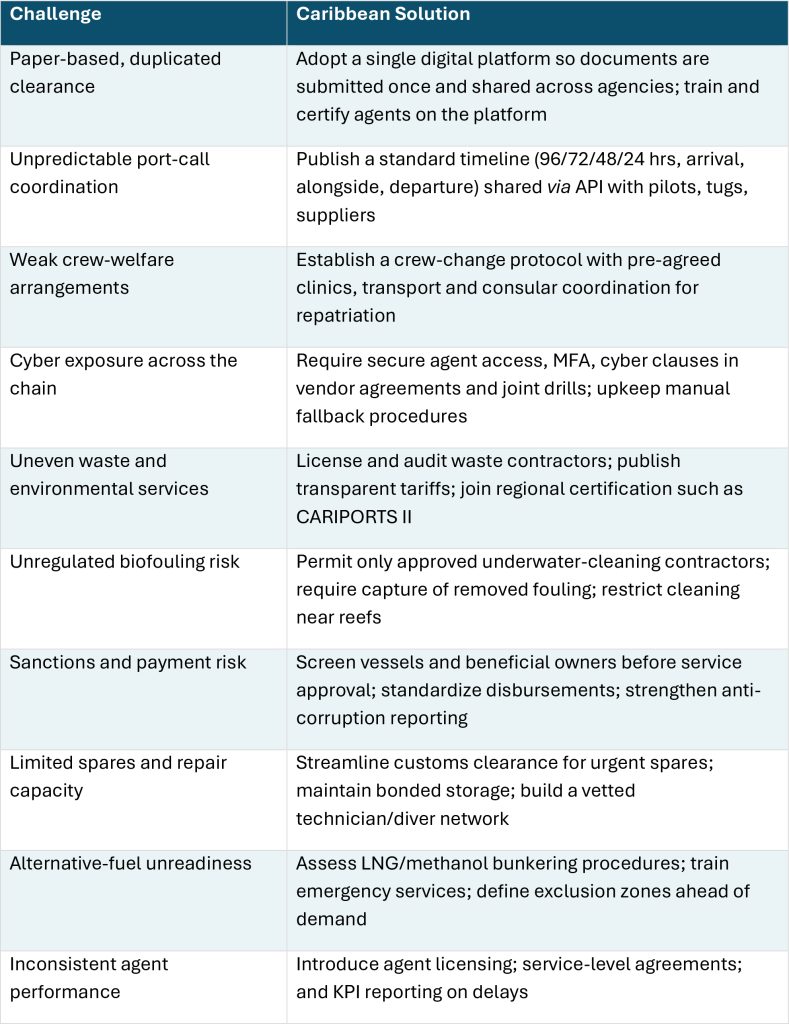
Turning Challenges into Opportunity
— TABLE 1 —
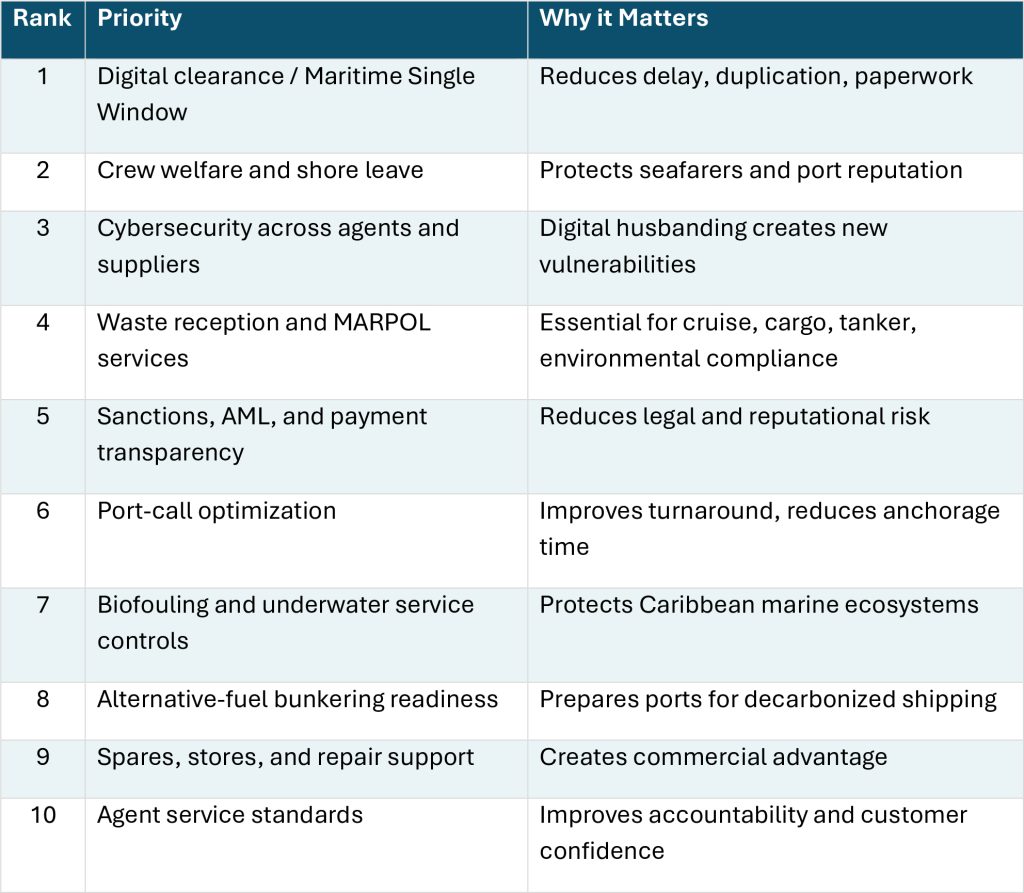
Regional Priorities
Not every challenge carries equal weight. Based on the risks in Table 1, Caribbean port managers should rank their focus roughly as follows:
—- TABLE 2 —-
___________________________________
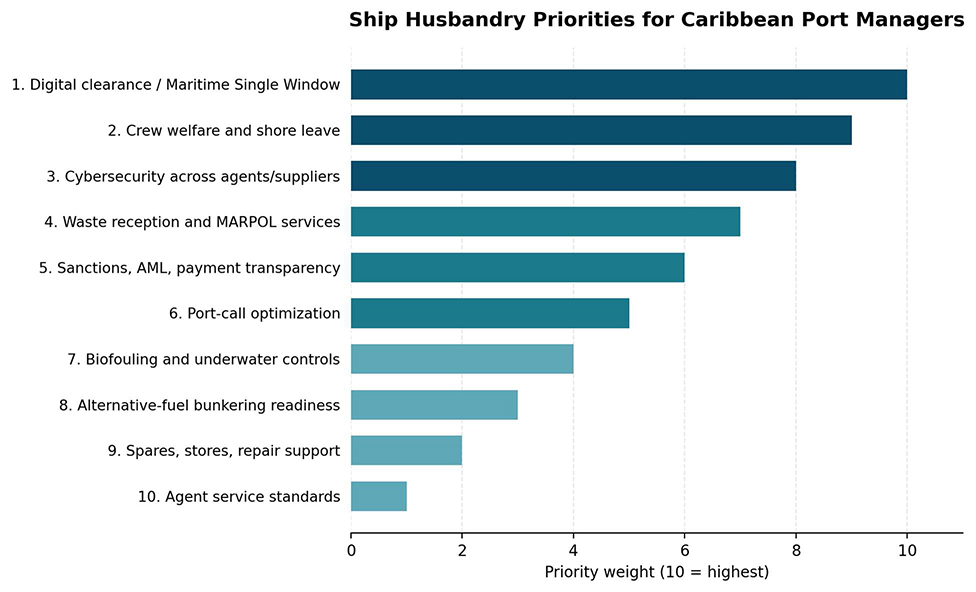
Figure 1: Relative priority weighting for Caribbean ship husbandry modernization
_______________________
Suggested 90-Day Starting Point
Port Managers in the Caribbean need not try to solve all 10 husbandry priorities all at once. These five suggested practical steps can build momentum within a quarter:
- Map the full husbanding process from pre-arrival notice to departure clearance, including every agency and document.
- Create a service standard for agents, chandlers, transport providers, waste contractors, divers and bunkering organizations.
- Establish a digital clearance improvement group with customs, immigration, port health, coast guard and shipping agents.
- Develop a seafarer welfare and crew change protocol covering shore leave, medical care, transport and denied leave procedures.
- Introduce a risk checklist for each port call covering sanctions, cyber, waste, fuel, crew and unusual vessel risk indicators.
The Bottom Line
Ship husbanding is becoming more digital, regulated, welfare sensitive, environmentally accountable and risk-based. And the Caribbean’s small port, agent dependent model makes response to the shifting environment more challenging than in larger hubs. But these developing constraints create an opening; an opportunity. Ports that modernizing husbanding now, ahead of regional peers, will be the ones that shipowners, cruise lines, offshore operators, yacht managers and energy companies choose first.
*** The goal for every vessel call should be simple: clearer, faster, safer, greener and better documented. []
FIRST PUBLISHED Portside Caribbean journal, September 1, 2026.
#SeaportManagement #PortManagement #PortServices
______________________________________

Colin P. Young, MSc., principal partner/consultant with Attune Consulting Inc., served as Regional Coordinator for the Caribbean with the International Maritime Organization (IMO) and as Port Operations Manager at the Port of Port-of-Spain, Trinidad and Tobago.[]