

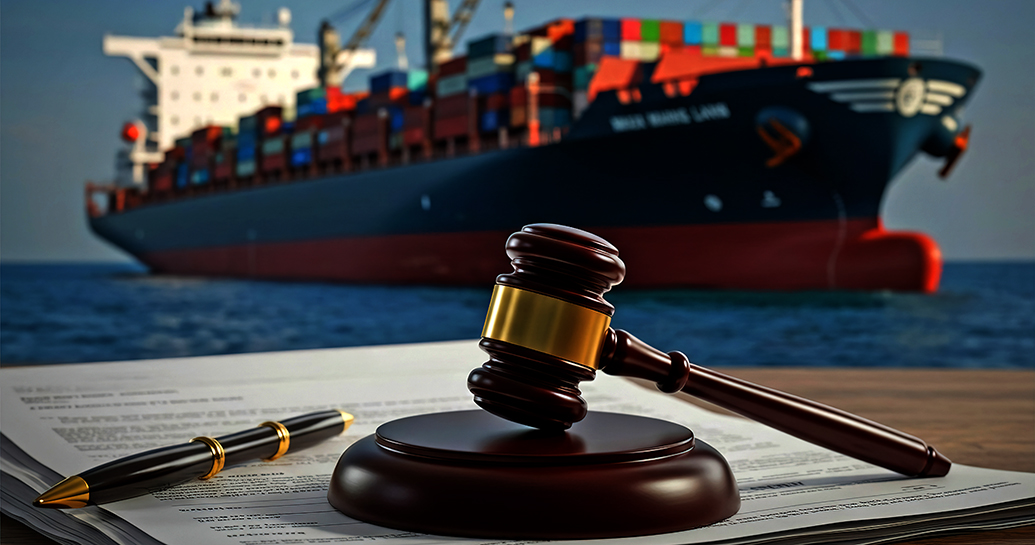
Power shifts, institutional strain and what lies ahead for rules that govern the seas
By Deniece M. Aiken
Oceans have always tested the boundary between power and law. In 1603, that tension surfaced when the ss Santa Catarina, a Portuguese carrack loaded with spices was seized by the Dutch. Portugal called the incident piracy. The Dutch however answered with an idea. Jurist Hugo Grotius argued that the sea could not be owned and that trade required open passage. His case for Mare Liberum (the free sea) became the foundation of modern maritime law.
Four centuries later the tools have changed but the dynamic has not. When the United States of America (USA) recently (January 2026) seized an oil tanker under sanctions enforcement, it argued the same logic: power justified through law, law shaped by power. Then as now, maritime rules are forged, not in calm waters but in moments of confrontation. Maritime law has never been neutral. It evolves when states act; when ships are stopped; and, when legal arguments are presented in order to legitimise force. Yet, the past is not a prologue. It is still playing out at sea.
Under pressure
Presently, the international maritime legal framework is under pressure. The global system is entering a period of geopolitical tension not seen in decades. Strategic rivalry among major powers, economic nationalism, sanctions and security-driven trade policies are reshaping how states interact at sea. Shipping lanes are no longer viewed solely as commercial corridors but as strategic assets. And the legal instruments once designed to smooth trade are increasingly being used to project influence, enforce policy or signal resolve. At the same time, the institutions meant to manage cooperation are facing growing scepticism and financial strain. Multilateral bodies that once set standards and quietly resolved disputes are now contested, underfunded, or bypassed altogether. Where consensus once smoothed enforcement, politics now fills the gaps, making compliance uneven and the application of maritime law increasingly selective.
The result is a shift in the character of maritime law itself. What was long considered a technical, specialist field, concerned with safety, liability and navigation, is becoming a frontline arena for global politics. For governments, businesses, insurers and port operators alike, the question is no longer whether geopolitics affects maritime law but rather how deeply it will redefine it and how prepared they are for the change.
 Fragmented international order
International relations are not collapsing into disorder but there are competing ideas and theories about how the world should be governed. Great-power competition has again taken centre stage. Sea lanes, chokepoints and offshore resources are increasingly viewed through a strategic lens, not merely a commercial one. And governments are now more willing to intervene in shipping, finance and logistics, even at the cost of efficiency. There is a clear shift away from universal multilateralism toward selective cooperation.
Smaller groups of aligned states are collaborating by setting their own standards, while global consensus becomes harder to achieve and easier to bypass. Maritime law is at the convergence of all these forces. It governs the movement of goods, energy, data and people across borders; and, when political order fragments, the law of the sea absorbs the pressure.
A clear signal of this shift came early in 2026 with the decision by the USA to withdraw from several international organisations[1]. In early 2026, the USA announced its intention to withdraw from 66 international organizations, including 31 entities associated with the United Nations. This decision was presented as a recalibration of national interest to address inefficiency, politicisation and misalignment with USA’s priorities. Regardless of the stated rationale, the consequences extend way beyond diplomacy. International maritime governance depends on coordination; shared standards; technical cooperation; and, the participation of major maritime powers.
When a leading actor steps back the system does not collapse but its universality weakens. The result is a world in which the rules still exist but their application becomes uneven. And in maritime law, uneven implementation is often where uncertainty, cost and conflict begin.
UN financially strained
This fragmentation is unfolding against the growing strain on the multilateral system itself. The United Nations (UN), the quiet scaffolding behind international cooperation, is facing serious financial pressure[2]. Its Secretary-General, António Guterres, has warned that persistent funding shortfalls could leave the organization struggling to function.
 For maritime law, the implications are immediate. Many of the UN’s most important functions are out of sight: technical assistance to states; shared data systems; dispute facilitation; and, coordination across agencies. These mechanisms energise legal principles, turning written rules into workable practice. They are often the first to be trimmed when budgets tighten, slowly eroding global industrial capacity. As that institutional backbone weakens, risks are that maritime law drifts away from shared stewardship toward something more transactional. Rules remain on the page but outcomes increasingly depend on leverage, resources and bilateral bargaining.
In such an environment, power does not replace law but it bends it, quietly and persistently. And, as history reminds, the law of the sea changes most drastically when power shifts across the oceans.
Caribbean impacts
For Caribbean states, these shifts are not abstract. They impact port operations, freight rates, insurance premiums; and, the daily movement of cargo that sustain small economies. In a fragmented maritime order, small and trade-dependent states experience the effects first and, often, most sharply.
Ports in the Caribbean are positioned along some of the world’s most heavily trafficked sea lanes, yet they operate with limited margins for disruption. When maritime law becomes more politicised, uncertainty naturally follows. Sanctions enforcement; enhanced inspections; and, shifting compliance expectations can (and often will) slow port clearance, increase administrative burdens and raise costs for carriers and cargo owners alike. Even when Caribbean jurisdictions are not the target of geopolitical measures, they can become collateral checkpoints in a more securitized maritime environment.
Ship operators face similar pressures. Insurance and financing decisions are increasingly shaped by geopolitical risk rather than purely operational performance. Vessels calling at smaller ports may encounter higher premiums or more stringent ‘due-diligence’ requirements; not because of local failings but because global risk models are tightening. In such conditions, reputation and regulatory credibility become as important as infrastructure.
For Caribbean governments, the challenge is compounded by capacity. As multilateral institutions weaken and technical assistance declines, more responsibility shifts to national authorities often without corresponding resources. Port State Control, beneficial ownership transparency, environmental enforcement and sanctions compliance all demand expertise and investment. Where these systems lag, jurisdictions risk being viewed as weak links in a tightening global chain.
Opportunity
Yet, there is also opportunity. Jurisdictions that demonstrate clarity, consistency and cooperation can distinguish themselves. Strong maritime administration; modern port governance; and, regional coordination can reduce risk perceptions and attract business seeking stability in uncertain waters.
Above all, this moment underscores a hard truth: maritime law no longer operates in the background. For Caribbean states and industries, it is becoming a strategic factor, shaping access, cost, and competitiveness.
The future of maritime law is unlikely to be defined by collapse but rather by sustained tension between cooperation and competition; and, global norms and national interests. The rules of the sea are not vanishing but they are being reshaped, under strain. The withdrawal of the USA from several international bodies and the growing financial fragility of the United Nations, are not isolated events. They signal a broader shift toward a more fragmented and transactional global order … one in which coordination is harder; enforcement less uniformed; and, power more visible in the making of rules.
Climate change mitigation in shipping relies on shared frameworks and credible oversight. As governance fragments, progress risks becoming uneven, with ambitious standards in some corridors and regulatory gaps in others. The same is true for economic diversification and digitalization. In this environment, maritime law is becoming a strategic domain in its own right. And how smoothly, fairly and safely the world’s seas continue to connect us will depend not only on the strength of the rules but on a collective will to sustain them in an era where cooperation is harder to achieve yet more necessary than ever. []
[1] https://www.whitehouse.gov/presidential-actions/2026/01/withdrawing-the-united-states-from-international-organizations-conventions-and-treaties-that-are-contrary-to-the-interests-of-the-united-states/
[2] https://www.ibtimes.co.uk/un-warns-financial-strain-trumps-us-funding-pullback-factor-1775244
FIRST PUBLISHED April 20, 2026
#MaritimeLaw #CaribbeanPorts  #GeopoliticsCaribbeanImpact  #CaribbeanEconomies

Deniece M. Aiken, PhD, legal expert and consultant (maritime law, governance and innovation); former president of WISTA Jamaica; and, member of the European Society of International Law, is currently engaged in advanced maritime legal research, evaluation and implementation of projects in the European Union.